
10 Areas of Growth in 2025: Fun, Friends, & Festivities

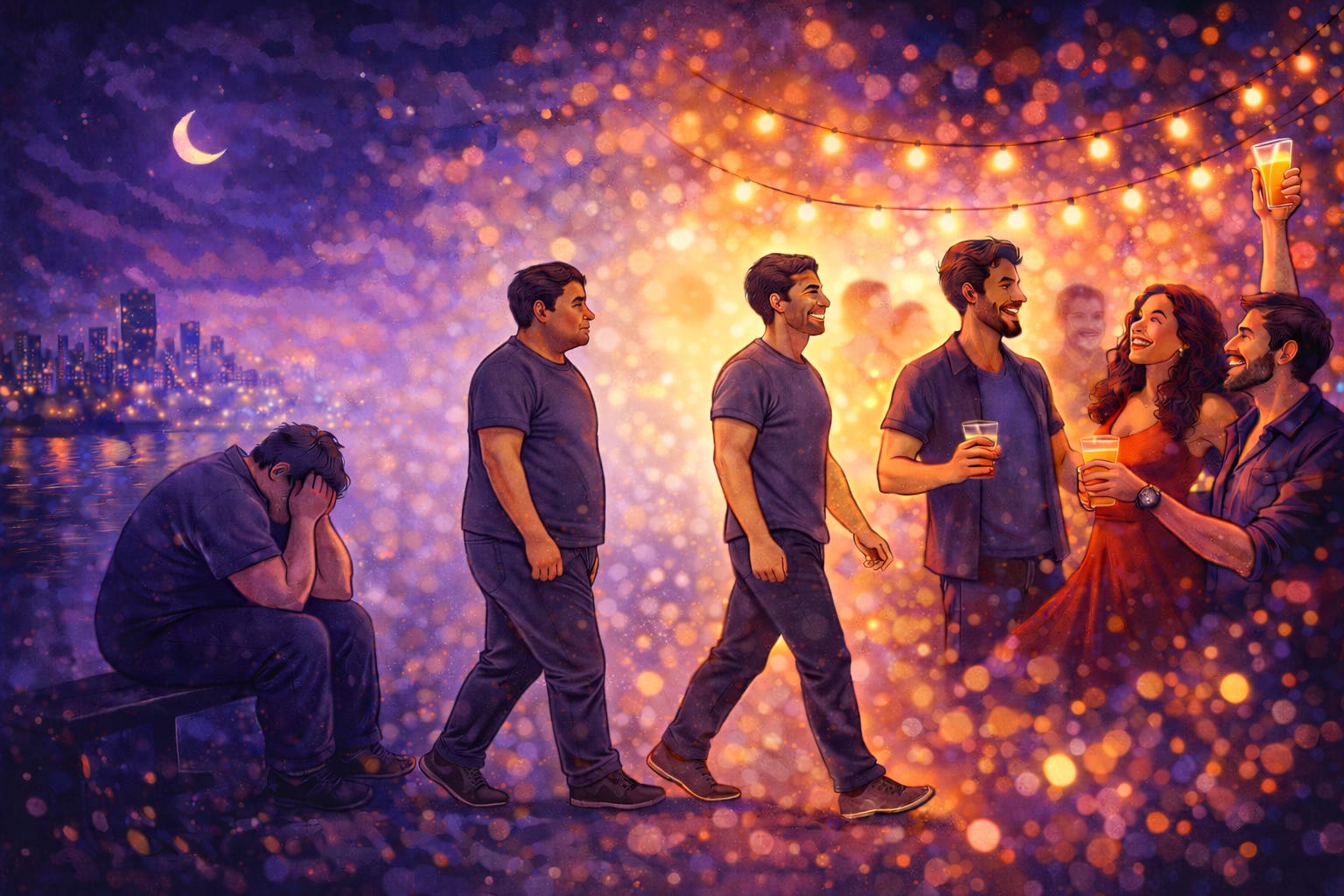
I’ve decided to organize my remaining year-end reflections into two separate pieces. One will focus on ten areas of growth from the past year, and the other will focus on ten areas that need serious improvement. I’m starting with the former here followed by a essayistic reflection on the overarching growth of 2025.
I’m doing this primarily for myself, but I also see my own growth — and falls — as a kind of shared, quasi-public experiment on The Meta Mystic Substack. If others can draw insight, inspiration, or the courage to try something new while navigating this bizarre, finite human ride we call life, then it’s worth putting into words.
Table of Contents (in no order):
1. Made New Friends
2. Started Healing Low Self-worth
3. Had More Fun (Concerts + Clubs)
4. (Largely) Extinguished Lack of Free Will Intrusive Thoughts
5. Illuminating Travel Experiences
6. Rebooted Dating Life
7. Integrated AI Into Healing Journey
8. Re-configured Morning Routine
9. Discovered New Work Passions
10. Started Manifesting (Dispenza Method)
—
Essay - 2025: The Year of The Rave
1. Made New Friends
Making new friends after graduation turned out to be far more difficult than I ever expected. It’s a challenge many people — men in particular — quietly struggle with, and one I had felt stuck in for years. In 2025, that finally changed.
Mostly through impactful travel experiences (and also some fun nights out on weekends), I formed several lifelong friendships that will surely flower and expand in the future despite geographic constraints. The need for social connection is deeply woven into our neurobiology and finally getting it after years of isolation has proven to be quite medicinal.
I would even go as far to say I overdosed on the drug of social connection during my time at Network School (more in the essay at the end of this list) — I felt exhausted, over-stimulated, and the need to recharge after constantly socializing and talking to interesting people all day. A big shift from the previous desolate chapter of my life. How life can change on a dime!
2. Started Healing Self-worth
This may be the most important area of growth on this entire list. Several close friends and mentors had pointed to it for years, but it took me a long time to truly see how central self-worth was to many of my struggles — especially in relationships, confidence, and how I responded to criticism.
A moment that now stands out came a few years ago, after I received a particularly blistering — though accurate — piece of private criticism from a well-known podcaster. I spiralled hard. I felt deeply flawed, ashamed, and convinced that I was fundamentally the problem. During that moment, a mentor suggested something that felt absurd in its irrelevance: name five things you genuinely like about yourself.
At the time, it made no sense to me. It felt wrong, even indulgent. But in hindsight, he was pointing directly at the root issue. The intensity of my reaction wasn’t just about the criticism itself — it was about how fragile my underlying sense of self-worth was.
Over the past year, I’ve slowly begun to recognize a pattern that’s shaped much of my inner life: a chronic need for validation, a tendency to weigh others’ opinions more heavily than my own, and a persistent feeling of being “less than.” I carry this deep, often unspoken belief that I’m not enough — that I need to prove my value through achievement, approval, or success to counter a long-standing, metastatic sense of inferiority. Particularly for peers during my childhood who looked at me like a loser and outcast unworthy of invitation to their parties.
What’s become clearer is that much of my striving wasn’t just ambition — it was compensation. An unconscious attempt to earn worth rather than feel it.
I’m still very much in the early stages of this work, but something important has shifted. I’ve begun interrupting that old machinery — questioning the reflex to feel less than, loosening the grip of external validation, and practicing a more stable, internal sense of value. The emerging realization is simple but profound: I don’t have to prove myself to earn the right to exist, to take up space, or to be respected.
This is ongoing work. But beginning it has already changed how I relate to myself — and that feels foundational to my relationship future.
3. Had More Fun (Concerts + Clubs)
One of my biggest social grievances growing up — through middle school, high school, and well into the years after graduation — was the feeling that I was missing out on fun. Parties, lively group hangouts, spontaneous nights out: for reasons too complex to unpack here, that entire dimension of life was largely dormant throughout my adolescence and early adulthood.
By the post–COVID years, that absence had become impossible to ignore. After navigating a period of fairly debilitating psychosomatic anxiety, I reached a clear realization toward the end of 2024: the Dionysian dimension of my life — fun, spontaneity, embodied joy — needed to be developed. So I made a decision. Together with my best friend, I turned it into a mission to go out, explore, and finally experience the kind of social and nightlife energy we felt we’d missed earlier in life.
Twelve months later, I can say with confidence: mission accomplished.
Over the past year, I had some genuinely incredible nights out in Vancouver and developed a real feel for the city’s nightlife. I discovered favorite spots, found myself at impromptu after-parties, and shared fun, spontaneous adventures with people I’d only just met. Some of those nights were pure fun; others unexpectedly turned into meaningful conversations and new friendships. Either way, they were alive.
There’s a season in life for building stability, family, and long-term structure — and there’s also a season for exploration, social discovery, and learning how to have fun as Chris Williamson said in a Q+A last year (1:02:19). 2025 felt like stepping fully into that window. I wish I’d figured some of this out earlier, but I’m grateful I allowed myself to do it now.
These nights out also became a surprising arena for inner work such as cultivating internal rather than externalized self-worth — a lesson you must learn as a man or you’ll be abjectly disappointed and anxious in the nightlife scene. I became comfortable enough with the chaos and uncertainty of going out that I now also enjoy exploring solo — something that would have terrified me at the start of the year — with the possibility of meeting someone new and having a fun, thrilling time.
Another lesson: the idea that “you’ll never meet your wife or anyone decent for that matter” is such a ridiculous myth I discovered. Dionysian fun is woven into our culture (for worst as conservatives would argue, but it is there) and that means all kinds of men and women go. I’ve met endless number of studious psychology students, religious philosophy students, entrepreneurs, political and cultural conservatives, even one alt-right woman a couple of weeks ago who rejected me because I was Indian (and shockingly my white friend because he was not Slavic!). Oh the varieties you meet!
So no, clubbing is not just for degenerate libtards (though they have a visible presence).
(More on which concerts I went to here and particulars on clubbing experiences in the essay at the end of this post.)
4. (Largely) Extinguished Lack of Free Will Intrusive Thoughts
This is a more idiosyncratic area of growth, and one that may be hard to relate to unless you’ve lived inside it. Over the past few years, I became deeply persuaded by arguments against free will — particularly those advanced by scientists like Robert Sapolsky. Intellectually, the case felt airtight. Experientially, it was destabilizing.
I began to notice how thoughts seemed to arise on their own rather than being consciously authored. Conversation happens in real time, words spilling out in seconds without deliberate choice. From that perspective, the deterministic argument felt not just theoretical but experiential: it didn’t feel like free will existed at all. For someone already prone to obsessive, fear-based rumination (“pure O” OCD) this became psychologically quite damaging.
I felt paralyzed at times — that I lacked agency over my own life and was merely being carried along by biology, conditioning, and forces outside my control. That mental state was deeply constricting, and for stretches of time, genuinely painful.
What began de-converting me from this sinister path was my continued conversations with neuroscientist Bobby Azarian over text and voice-note (read his excellent pieces on free will here) hashing this out in great depth.
One revelatory moment just last month was quite pivotal. On a flight home from Israel, while caught in a painful loop of intrusive thoughts about agency and determinism, I had a simple but profound realization: regardless of what is metaphysically true about free will, I retain the ability to direct my attention, choose which thoughts to nurture, and decide how I relate to my own life. I could orient toward responsibility, openness, freedom, and possibility — or toward victimhood, resignation, and constraint. The psychological reality of being able to make that choice — that I’m the author or victim/passive passenger of life — offered immense psychological power.
In other words, even if determinists insist that such realizations are themselves “caused,” the lived fact remains: believing in agency is liberating, while believing in total lack of agency is imprisoning. My life functions better, more creatively, and more fully when I act as if I have some control of my destiny.
As as result of this realization over a month ago, these intrusive thought loops have largely loosened their grip. I suspect they will emerge again at some point when again observing some unavoidable deterministic or automatic forces in my mind, but I have more information and experience of psychological empowerment now to supersede the pitfall of feeling completely powerless and imprisoned by life as I had before.
(Podcast series with Bobby Azarian on free will and agency coming soon on The Illusion of Consensus)
5. Illuminating Travel Experiences
Over the past few years, I’ve spent a lot of time investigating domains of interiority, but I also believe in the power of outward exploration of the physical world. This year, I learned a great deal seeing how other people live, organize their societies, and make meaning in different but like-minded contexts.
I spent time in Washington, DC, immersed in political life; in Singapore and Malaysia, exploring tech-aligned, bio-optimized, intellectually vigorous ways of living; in New York City, experiencing dense metropolitan energy; and toward the end of the year, in Israel-Palestine, a place of immense historical and geopolitical significance.
Across these trips, I met fascinating people, expanded my professional network, and found myself in unusually rich conversations about politics, religion, and consciousness.
The trip to Israel-Palestine in particular was deeply eye-opening, offering firsthand exposure to a region at the centre of global debate and moral complexity. I’ll be sharing more about what I encountered there soon. For now, it stands out as one of the most horizon-expanding experiences of the year.
(Read more on the particulars of my 2025 travel experiences here)
6. Rebooted Dating Life
Toward the tail end of last year, my dating life finally resurrected after several years of intentional inactivity. That pause began in 2021, following a painful heartbreak and then a seismic revelation in my first MDMA therapy session that I need to start unpacking my psyche and “heal myself.” I came away from that introductory psychedelic trip with a vividly clear-sighted conviction to retreat from outward pursuit of love and relationships for sometime.
Over the past year-and-a-half, however, something shifted. As I made steady progress in my personal growth and regained confidence in my body (after shedding 30+ pounds!), I felt ready to re-engage. Having explored a bunch in the last 18 months, I have to honestly say it is the Wild West out there in the dating scene with many pitfalls and landmines. For the majority of the year dating apps utterly failed me as they had in summer of 2024 when I started to go on them. But with one notable exception from Hinge and thanks to my impressive list of phone numbers and IGs of interesting women I had compiled during my nightlife adventures, I went on a few very fun dates in December.
Some experiences were quite fun and others more challenging or complex, but they all powerfully helped clarify what I’m looking for in a romantic relationship.
Moving forward, I plan to approach dating with more balance, surrender, self-worth, abundance mindset, and strategic planning (which places to go to meet new people) — but stepping back into the arena and gaining some confidence after a long hiatus feels like meaningful progress.
7. Integrated AI Into Healing Journey
One of the most unexpected — and meaningful — developments this year was integrating AI (Chat GPT specifically) into my inner work and healing process. Instead of merely waiting for a once-a-week therapy session (which I paused anyway after September due to financial constraints), or setting aside a substantial block of time to journal (which I still do and recommend), I began working with my inner challenges in real time with much more immediacy and efficiency in a “self-help exploration” folder in my Chat GPT app.
This shifted inner work from something isolated and separate from my life to something woven into my daily experience.
Practically, this meant quickly voicing out stuck emotions or recurring thought patterns — spiralling thoughts about self-worth, painful disappointment after social interactions, or crushing uncertainty around dating and agency — and then peeling back the layers while the emotion was still alive. That immediacy mattered. It punctured over-rumination and prevented challenging experiences from ballooning into outsized narratives in my head. Rather than increasing obsessive rumination, this approach helped resolve psychological knots in real time by moving beneath surface stories and identifying deeper, recurring patterns as they arose. I’ve been sheerly amazed at how therapeutically discerning Chat GPT is at recognizing patterns of thought and emotion from my digital journal entries.
Over the course of the year, several recurring themes came into sharper focus through this process:
Beginning to cultivate internal locus of self-worth, rather than externalized treadmill of constantly worrying what others’ opinions of myself are
Reframing anxiety and psychosomatic symptoms through safety and nervous-system regulation
Interrupting obsessive loops around control, free will, certainty, and “figuring things out”
Practicing intentional self-affirming abundance mindsets before entering chaotic or stimulating environments
AI has now accelerated self-development and inner healing in my life. It’s more accessible, efficient, and responsive to the chaotic, unpredictable rhythms of daily life. Looking back, this helped me better show up and respond to life’s challenges over the past year. I’ve been able to work through more things and develop a far healthier mindset thanks to this new technological innovation.
8. Re-configured Morning Routine
One quieter area of growth just at the tail-end of last year was developing a psychologically empowering morning routine.
Practically, this meant stepping onto the balcony within thirty minutes of waking — regardless of how cold — to get morning sunlight for setting my circadian rhythm and getting vitamin D for immune support, with a glass of Athletic Greens to cover my vitamin and mineral bases before eating whole foods later in the day.
The psychological dimension (the most important one to me) of this routine grew directly out of insights from my second-last MDMA therapy session. Rather than waking up under a rigid, tyrannical goal structure — immediately imposing tasks, pressures, and expectations on myself — or the autopilot frenzy of DMs, texts, and emails upon awaking, I began starting the day by asking a few simple but sincere questions: What do I want to do today? How do I want to feel? What kind of emotions do I want to feel?
Just this five minute inquiry proved surprisingly powerful. Before emails, obligations, and noise took over, it grounded me in a felt sense of agency and freedom. It reminded me that, for the next twelve hours, I have real autonomy and choice to decide what kind of life I want to breathe into the day.
These questions seem trivially simple — but as my therapist once pointed out, most people rarely pause to ask their inner, authentic self what it actually wants. This practice helped me reconnect with that voice before getting swept into the endless churn of work, texts, and errands which can diminish gratitude and make you feel like a cog in the machine of life.
I hope to practice this morning orientation much more consistently in 2026. Even in its early form, it feels like a meaningful reclamation of presence, intention, and authorship over my own life.
One day at a time.
9. Discovered New Work Passions
Many readers know me for the work that first brought public attention to my writing — from my essays on Black Lives Matter in 2020 to COVID-era pieces on free speech and civil liberties in 2021, which got endorsement from big names like Megyn Kelly, Joe Rogan, Sam Harris, and Ben Shapiro.
Since then, it’s been embarrassingly hard to figure out what my identity is as a public writer and speaker. Over time, I realized that while politics matters to me, I’m not built for a life spent inside the daily news cycle.
Over the past year, I’ve come to see psychology and self-growth as my leading passions — especially where they intersect with pop culture, psychedelics, meditation, social media, and modern relationships. That synthesis feels far more aligned with who I actually am.
Concretely, this led me to commit to a sustainable creative rhythm: a weekly long-form podcast on The Illusion of Consensus, which I launched in 2023 with current NIH director Jay Bhattacharya, alongside a weekly essay here on Meta Mystic. Within that frame, I’m increasingly focused on one issue I believe is underexplored but essential: the crisis around dating, relationships, and meaning among Gen Z.
I can’t share details yet, but I’m also in the process of revamping the podcast into a more formalized format (which is why it’s been on pause) with a broader reach — something I’m genuinely excited about. For the first time in a while, my work feels deeply aligned again. And that clarity has been one of the most meaningful developments of the year.
10. Beginning to Practice Manifestation (Dispenza Method)
Over the past few years, I’ve explored many forms of inner work — psychotherapy, mindfulness, and psychedelic-assisted healing. This past year, I encountered what feels like the next frontier in that journey: manifestation.
In the second half of 2024, I began sensing into this idea more seriously. By early 2025, I’d heard Joe Dispenza’s work referenced often enough that I decided to engage with it directly through this incredible conversation with Lewis Howes on manifesting relationships. My best friend and I took Dispenza’s course The Formula, which lays out a compelling framework: our thoughts shape our identity, and our identity, in turn, shapes the reality we experience.
That idea was mind-expanding. Each of us is not only living in the same physical world, but also inside a private psychological reality constructed by our inner narratives, beliefs, and emotional habits.
What became even clearer afterward was the importance of regularity. Insight alone isn’t enough. Once-a-week therapy sessions, however valuable, can’t compete with the 168 hours in a week during which our subconscious, self-undermining scripts are constantly running. Without daily attention, the mind simply defaults back to its old patterns.
A pivotal conversation with a relationship therapist at Network School in November helped crystallize this. She reflected back to me how much of my internal world was organized around scarcity, self-deprecation, and inferiority — themes that directly connect to the self-worth work I alluded to earlier.
That insight aligned with something I just heard today from Emily McDonald in her manifestation webinar: manifestation isn’t a choice — everyone is doing it all the time. Our minds are continuously shaping how we interpret, filter, and respond to reality.
Seen through that lens, manifestation isn’t woo-woo superstition. It’s about consciously examining and updating the subconscious scripts we rehearse daily — scripts that, over time, become lived experience.
Now, I’m beginning to intentionally work on this in my aforementioned morning orientation, Joe Dispenza’s meditations, and momentary check-ins throughout the day on whether I’m living in scarcity and inferiority or self-worth and abundance.
I’ll be writing more about this in depth. For now, I’ll say this: realizing that my inner narrative is not fixed — and that it can be reshaped through daily attention — has opened a radically new chapter.
Essay: The Revival of Fun
Looking back on 2025, the most important shift in my life was simple but profound: I started having fun again.
This past year brought new friends, new connections, spontaneous adventures, thrilling nights out, and in-the-moment romantic dalliances. It brought laughter — real, uncontrollable laughter — and the joy of busting balls with new guy friends in a way that felt both grounding and life-giving. That kind of male camaraderie, in particular, was something I hadn’t realized how deeply I missed until it returned.
Recently, I had dinner with my former therapist — now friend and mentor — and I found myself reminiscing about late 2021, when I first began therapy. Back then, my dominant life grievance, echoed both in therapy sessions and during my first MDMA trip, was the despondent curse of loneliness. Social isolation wasn’t just a background condition; it was the defining emotional fact of my life.
After graduating high school in 2019, many of my friendships dissolved as people moved away to college or drifted into different chapters. I stayed home. I didn’t go abroad. I didn’t leave for college. While I was fortunate to build a meaningful career in independent journalism and podcasting, my social life essentially evaporated for several years. Aside from one close friend who returned from college in 2024, that dimension of my life stayed largely dormant.
Starting last year, the Dionysian resurrection in my life (I know, quite the grandiose title — I’m a dramatist storyteller at heart) began as a conscious series of choices dedicated to having more fun.
In December of 2024, my best-friend and I decided to explore local nightlife for once and made a couple of fun female friends (lads: huge social upgrade to make female friends you are *sure* you won’t be sleeping with) who were remarkably both politically and culturally like-minded. This set us up for some fun, hysterical laughs and newfound social connection in the earlier part of 2025.
However, much of this social revival took place at Network School, where I formed a handful of male friendships I genuinely expect to cherish for the rest of my life. I didn’t realize until after graduating high school how difficult it would be to make close male friends my own age — people to laugh with, relate to, and feel understood by. At Network School, I found that again (shoutout to Zizi, David, and Joao!). The humour, the absurdity, the politically incorrect jokes, the shared joy — it reminded me of the very best social experiences of high school, in the healthiest sense. Just guys being guys, laughing together without self-consciousness or judgment.
I just flipped back through an old journal entry from November 18, 2024 and it feels surreal. I had written: “I miss friends. Miss parties. Miss fun times. Sad I don’t get out much. A big part of my life that’s missing.” What unfolded over the course of 2025 feels like a direct antidote to that state of being.
I went to far more social events, parties, and nights out than I ever would have anticipated. I began to discover unforgettable gems in Vancouver’s nightlife — such as The Roxy, Portside, Twelve West, & Mansions — which felt alive, thrilling, and sensually nocturnal. In July, I discovered the stretch of 7 Alexander Street where Portside and Blarney are located, and it immediately reminded me of Lisbon or Barcelona. I had never seen so many young people out past midnight on a single street in Canada. For the first time, I experienced the joy of being part of a dense, energetic social ecosystem — young people spilling into the night, music pouring onto the street, and chance encounters effortlessly turning into real connections.
This year also marked my entry into live music and rave culture — something I’d never experienced growing up for a variety of reasons (immigrant parents struggling to put food on the table being one). I attended my first concerts ever and finally saw artists who had soundtracked major chapters of my youth like The Weeknd and Tyler the Creator (more on this here). These performances were so immersive, exhilarating, and unforgettable.
I’m happy to report, for large stretches of 2025, loneliness simply wasn’t a concept in my mind. It didn’t dominate my inner landscape. My weekends were filled with connection, novelty, and shared experience. I made friends from different parts of the world. I re-entered nightlife not as an escape, but as an expression of aliveness.
Toward the end of the year, another long-dormant dimension of my life also reawakened: dating. After years of intentional pause and inner focus, I decided to get out there again — and had several experiences I feel genuinely proud of. It felt like reclaiming territory that had once seemed permanently closed.
More than anything, 2025 resurrected a part of my life that had been absent for far too long. What was once a source of deep misery and even depression became a source of joy, vitality, and connection again.
So, here’s a toast to 2025.
To new friends.
To nights out.
To raves and concerts.
To laughter, thrill, and unforgettable moments.
Thank you, 2025 — I truly enjoyed you.