


Note to readers: I had no idea yesterday was Chamath Palihapitiya’s 50th birthday. I’ve been contemplating this piece for months, and over the past few weeks and days, I’ve edited and rewritten it more times than I can count because of how much depth it stirred in my own inner world. You can read Chamath’s birthday piece here, which offers a brief primer on his life journey for those unfamiliar with it. Thanks to the universe for timing this all a little too serendipitously. Hope to see everyone at the All-In Summit!
The ideal of the modern man is no longer merely the guy with the most money, fame, and hot women. At the cultural frontier, it’s increasingly the man who deeply understands himself, his impulses, and his shadows—and is willing to excavate the depths of his psyche to transcend patterns of intergenerational trauma. This represents one of the most consequential shifts in masculinity in recent years, yet it harkens back to Carl Jung’s idea that men must integrate their inner feminine dimension—the anima—to become whole.
- Rav Arora
Macro trends explored in this piece:
Therapy culture, age of media transparency, material abundance, South Asian diaspora, mental health.
Chamath Palihapitiya’s Most Important Investment: Healing His Self-Worth
By: Rav Arora
We humans look for models in the world—people who are struggling with, processing, healing, or have somehow solved the same interior and exterior problems that we ourselves are trying to navigate.
In a recent essay, I wrote about my own “internal family system” of visionary thinkers—from Sam Harris, Kanye West, and Jordan Peterson to Thomas Sowell, Alan Watts, Joe Rogan, Kendrick Lamar, and Aldous Huxley—each of whom has captured a part of my mind, from Peterson’s Jungian analysis of religious symbols to Harris’s meditative equanimity to Rogan’s insatiable curiosity & adolescent sense of play.
As my own journey has turned increasingly inward over the last couple of years, one core concept has occupied more and more of my attention: self-worth.
It is a phrase that was almost entirely absent from my vocabulary as recently as 2024. Now that I’ve seen it, I can’t unsee it. I see it everywhere, in places I never would’ve expected, as one of the pernicious forces underneath so many of my own pursuits: my ambition, my relationships, my need for approval, and even the identity I construct for myself.
“I still revert to basically running around asking other people what will make you like me more, you know what will make me more popular in your eyes and I try to do it and it never works, it is just a complete dead-end.”
- Chamath Palihapitiya on Lex Fridman’s podcast
In the last couple of years, two new confessional avatars (of wildly disparate arenas but reflective of the same core traumas) have entered my internal family system to help me make sense of the unworthiness driving my (increasingly conscious) pursuits of ultimate redemption: The Weeknd and Chamath Palihapitiya.
As the natural order of the universe seems to operate, when you’re struggling with a particular problem, you somehow end up stumbling across the people, ideas, and art that help you make sense of your pain.
For me, that happened in 2024 during one of my many Spotify expeditions, when I came across Canadian pop star The Weeknd’s first three Trilogy mixtapes.
Unlike some of his more derivative radio hits I had heard over the years (like Starboy), I was stunned by his earlier music’s instrumental extravagance and emotional rawness he depicts in songs like Wicked Games (“Bring your love, baby, I could bring my shame / Bring your body, baby, I could bring you fame”) and Lonely Star (“Baby, you can have the cars, the clothes, the jewels, the sex, the house / Baby, you could be a star”) — the attempt to fill an internal void through women, drugs, fame, and external validation.
Similarly, and more strikingly given his stature in Silicon Valley, Chamath—a billionaire venture capitalist who has achieved nearly every conventional marker of masculine success—has spent hours on long-form podcasts openly unpacking his childhood trauma, damaged self-worth, fear of abandonment, and pursuit of status. When I first came across some of his therapy-esque podcast interviews, I was amazed at how openly he shared his inner world.
A lot of billionares are indeed hitting the long-form, unfiltered podcast circuit these days, but they’re all talking about outward things (which are important, needless to say) on how to successfully found a company and the future of A.I. Chamath does all that too, but he also talks about his childhood trauma, feelings of inadequacy, and deep-rooted insecurities going back to his early years.
In this way, I see Chamath as archetypifying this novel, but well-founded shift in masculinity in our cultural zeitgeist:
The ideal of the modern man is no longer merely the guy with the most money, fame, and hot women. At the cultural frontier, it’s increasingly the man who deeply understands himself, his impulses, and his shadows—and is willing to excavate the depths of his psyche to transcend patterns of intergenerational trauma. He strikes a healthy balance between the extremes of the status- and money-obsessed red-pill subculture and the New Age, feelings-obsessed solipsist who elevates endless introspection at the expense of resilience and agency.
This represents one of the most consequential shifts in masculinity in recent years, yet it harkens back to Carl Jung’s idea that men must integrate their inner feminine dimension—the anima—to become whole.
For Jung, the anima represented the feeling-oriented, relational side of the male psyche—the part associated with love, intuition, tenderness, and connection to the unconscious. When a man fails to integrate those qualities within himself, he tends to project them onto women, experiencing a woman as if she possesses the missing depth, love, or wholeness he lacks. Romantic desire can then become unusually intense because he is not only seeking her, but also unconsciously seeking disowned parts of himself through her.
This shift is shaped by a few macro-level, societal trends. For one, Zoomers are increasingly breaking through the illusion that material possessions, financial success, and conventional metrics of achievement are sufficient to living a self-actualized, well-examined life. Outer abundance is not enough without inner abundance (which is the opposite of inner scarcity — the trauma-based fuel that runs the lives of the most successful people). In the podcast era, they see — rather than just read or hear nebulous rumours — how the world’s most prominent thinkers operate. As Elon Musk said on Rogan once:
“I don’t think you’d necessarily want to be me. It’s very hard to turn [my mind] off… It might sound great if it’s turned on, but what if it doesn’t turn off?”
Direct experience of the emptiness of outward success can be even more eye-opening. I jarringly realized over the past few years.
In 2020, my career suddenly took off. Only a year out of high school, I penned one of the most viral essays ever published in the New York Post on identity politics, leading to an unexpected career in journalism writing for the Post on BLM, de-policing across American cities, and cancel culture on college campuses.

To my sheer egocentric pleasure, I began receiving attention from places I could never have imagined—having my work praised by Megyn Kelly and Joe Rogan and, even earning the surreal privilege of appearing on Jordan Peterson’s podcast.
Rav—the loser from high school who shamefully couldn’t find a date to prom—was suddenly becoming an internationally recognized journalist.
And yet, around the same time, a very different story was unfolding internally: shortly after the drug-like high of virality wore off, an excruciating bout of unrequited love threw me for a wild ride, sending me desperately searching for answers. I tried a number of different modalities, but the one that provided the most immediate catharsis and profound psychological insight was MDMA-assisted therapy. More on that here for those curious:

Since then, weekly psychotherapy, meditation, nervous-system regulation, and more recently hypnotherapeutic manifestation practices (where you dig into subconscious beliefs and visualize a new future) have helped me understand and heal the inner wounds that guide my life.
Chamath has undergone his own dramatic shift inward.
On Tucker Carlson’s podcast, he described the insecurity he has carried since childhood as his psychological “dark passenger.”
“People with this dark passenger, lots of insecurity, they achieve a lot,” he explained. “But all of that, a lot is externally validated, but not internally felt. And so there’s just this sense that there’s an emptiness and people start to panic.”
Chamath is unusually candid about how that dynamic manifested in his own life. “I spent a lot of time, a decade basically, feeding that insecurity, buying things, accumulating things,” he told Carlson, reminding me of my favourite rapper Kendrick Lamar’s similar confession on Mr. Morale & the Big Steppers: “I bought infinity pools I never swimmed in.”
After becoming enormously wealthy, Chamath recalled buying a stake in the Golden State Warriors, befriending the players, celebrating championships with them, and partying with them in Vegas. For the self-described nerd who had grown up without much of a social life, suddenly gaining access to that world was intoxicating.
But the deeper psychological hunger remained. Chamath described himself as trying to fill an internal “jug” that had always been empty. Money gave him access to virtually every conventional symbol of success—watches, boats, planes, clothes—but the psychological payoff he expected never arrived. “I thought the watches would solve the problem,” he recalled. They didn’t. And even as the metaphorical jug began to fill, the goalposts kept moving: “your mind just switches the jug to an even bigger jug,” Chamath explained. “It gets closer to being full, and then it switches again, and it switches again.” Each new acquisition or achievement could temporarily soothe the insecurity, but none could generate the internally felt sense of worth he had been seeking through the outside world.
On Lex Fridman’s podcast, we can trace some of this behavior back to his childhood. He describes how his father would beat him with belts and tree branches (yes, intentionally depicted in the artwork for this piece if you look closely) as punishment for bad behavior. As Chamath puts it, “if what you get from [your childhood] is that you’re not worthwhile, that you’re less than many other people, when you enter adulthood or in your early 20s, you will be in a cycle where you are hurting other people and you may not know it.”
This kind of childhood dysfunction exists across cultures, but it is more pronounced in South Asian and other Asian immigrant families, where achievement can become deeply intertwined with worth, duty, and family pride. Look at who some of the highest-earning demographic groups are, as I’ve written before, and you begin to connect the dots. In many Asian subcultures, achievement is elevated to an almost sacred status: forget inner peace, self-love, or healthy relationships—becoming a doctor, lawyer, or engineer is the highest paramount pursuit. Ironically, some of the world’s richest traditions for cultivating inner peace—Hinduism, Buddhism, Daoism—also emerged from Asia, but that’s for another essay.
For much of my parents’ generation, economic and geographic security understandably came first. Successfully immigrating to a Western country with greater freedom and opportunity could be a life-defining achievement; mental health, self-examination, and emotional well-being were rarely afforded the same priority.
Chamath, as a second-generation immigrant in the West, represents the next stage of that story. He attained a level of material abundance his parents never did, only to discover that wealth could not resolve the psychological inheritance underneath it. In that sense, he is almost a next-gen version of his father—running the same inherited operating system while consciously trying to install new psychological software.
He made billions, accumulated nearly every conventional marker of success, and eventually realized that none of it offered a “substitute for liberation,” as Aldous Huxley wrote in his famous essay of the same name.
Chamath isn’t the only South Asian man grappling publicly with this struggle. Many South Asian artists and comedians have been telling versions of the same story. Jasmeet Raina (JusReign) built much of his early career satirizing the dysfunction of growing up in a Punjabi household, themes he revisits more seriously in his new show Late Bloomer. Comedian Hasan Minhaj’s recent stand-up special similarly explores therapy, childhood wounds, and the difficulty of bringing a modern mental-health vocabulary to his parents’ abjectly dysfunctional relationship.
And Aziz Ansari’s Master of None may be the most elegant fictional depiction of the modern South Asian immigrant experience. Dev, the protagonist Aziz himself plays, becomes increasingly disillusioned with the American dream and with modern relationships, eventually fleeing to Italy to learn pasta-making, where he develops a romance with a gorgeous, effervescent Italian woman.
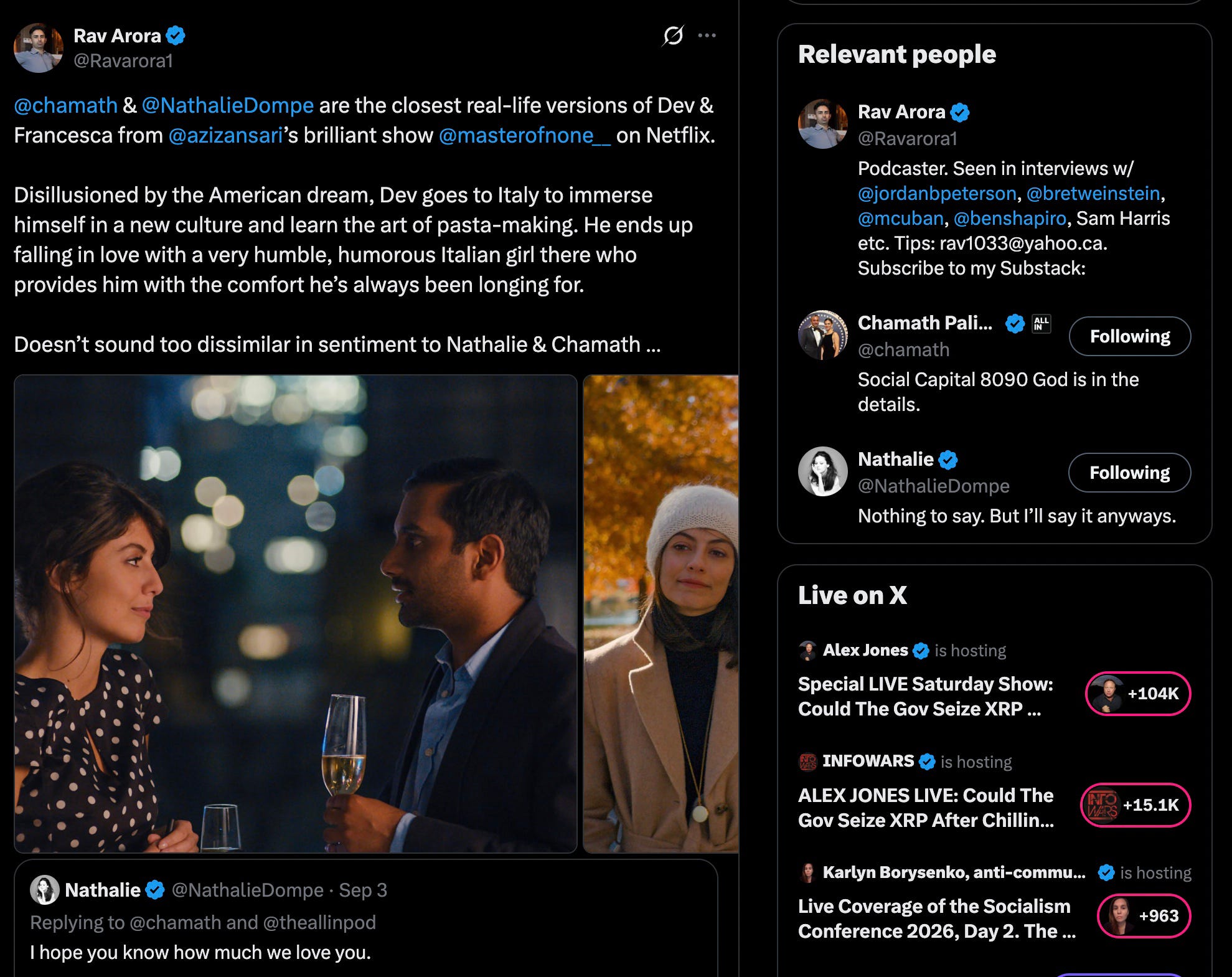
When I first saw Chamath and his Italian wife Nathalie together, Master of None was the first thing that came to mind: the ambitious South Asian man who has succeeded in one version of American life, only to discover that the next frontier is far more intimate—love, meaning, emotional freedom, and a life that actually feels good from the inside.
Sometimes reality imitates art.
Notably, the Chamath interview I watched with the most emotional depth and psychological insight is the one he did alongside Nathalie on Katie Miller’s podcast. There, the abstract language of childhood trauma and low self-worth becomes concrete in the most consequential arena of all: his marriage.
“Growing up the way that I grew up, I didn’t really have a lot of friends, [and] my parents fought a lot,” Chamath explains. “I was always very afraid of—I don’t want to be rejected by Nat.” That fear still surfaces during serious conflict: “I get very quiet because I do get into this mode of like, ‘What if she leaves?’” He describes retreating inward until the two of them eventually work through the argument.
Nathalie, in turn, describes the other side of that pattern: when something makes Chamath feel insecure or “smaller,” he can fall back into old ways from his childhood. Chamath acknowledges that without her willingness to push through the conflict, many of their disagreements would simply never get resolved.
What makes the exchange striking is not simply that these patterns exist—most couples have their own—but that they can publicly discuss them with such fearless openness. I’ve seen entertaining conversations with Sam Harris and his wife, Jordan Peterson and his wife, and Megyn Kelly and her husband, but rarely have I seen a public figure of Chamath’s stature dissect the challenges of his marriage in such an unvarnished manner.
This is emblematic of the emerging masculine ideal in 2026. Acquiring wealth, building companies, and being politically outspoken are still expressions of masculine agency. But increasingly, so is the ability to share your inner struggles and be emotionally vulnerable.
The biggest critique of modern therapy culture (voiced by my friend Abigail Shrier in her last book) is that it can devolve into emotional indulgence, wallowing in pain, and becoming more psychologically fragile rather than more resilient.
I’ll detail this in another essay, but my personal theory is that therapeutic self-exploration can certainly become unhealthy when it isn’t counterbalanced by forces like mindfulness, stoicism, emotional resilience, responsibility, and masculine purpose. Introspection is useful insofar as it helps you understand yourself well enough to act differently in the world.
In Chamath’s case, there is plenty of talk about feelings, childhood trauma, insecurity, and self-worth—but it is almost always connected back to his present behavior and the ways he is trying to change it.
In his recent video initially entitled, If You Were a Loser in High School, Chamath describes the “Gordian knot” still holding him back as “my sense of self-worth. It’s my sense of security. It’s this idea that I need everybody else’s validation.” The problem, he says, is “doing too much to seek that validation.”
He can now directly see how this insecurity shapes his behavior. “I know it because I can see it. I can see the facets of it,” he says. “And when I’m away from it in calm moments, I can see how I’ve made mistakes.”
On Lex Fridman’s podcast, he elaborates on the painstaking process of untying this “knot”:
“The way that my doctor explained it to me is, you have to think about your self-worth like a knot. It’s inside of a very complicated set of knots. Some people don’t have these knots—it’s just presented to you on a platter. But for some of us, because of the way we grow up, it’s covered in all these knots. So the whole goal is to loosen those knots. And it happens slowly, it happens unpredictably, and it takes a long time.”
And while those knots are being loosened, he explains, there will inevitably be moments when feelings of inferiority return and you are not yet able to look inward and reassure yourself: “Actually, here’s how I feel about myself. It’s pretty cool. I’m happy with where I’m at.”
That, to me, is the productive version of therapeutic introspection: not endlessly excavating the past for its own sake, but gradually untangling the psychological knots that keep you dependent on external validation—so that they exert less unconscious control over how you behave, what you pursue, and ultimately how you feel about yourself.
Similar to Chamath, since beginning my own psychological excavation, I have slowly started to see how a deeply embedded sense of unworthiness has shaped far more of my life than I previously understood.
For example, I’ve realized in my dating life I’ve carried this inner belief that I am somehow not enough for a beautiful, high-quality woman. That she exists far above me; that my presence alone is insufficient to earn her interest. I have to impress her, prove myself, flex my career, say the right things—to somehow demonstrate that I am worthy of being chosen. Underneath all of that striving is a simpler belief: There is something wrong with me. I am not enough.
Once I saw that pattern, behaviors that had previously seemed irrational became easier to understand. A delayed text or being ghosted could trigger wildly disproportionate rumination—not merely because someone had lost interest, but because it activated the deeper question: What is wrong with me? What did I do wrong? Why wasn’t I enough?
But I’ve increasingly realized this isn’t merely a dating problem. I’ve noticed the same dynamic with more distant or emotionally unavailable members of my extended family. When I’ve tried to become closer to a relative and the effort wasn’t reciprocated, the rejection could activate the same inadequacy—and, perversely, intensify my desire to win their approval. That was an important realization: this pattern isn’t confined to romantic relationships. It colors the way I seek connection more broadly.
One of the most acute revelations came during an MDMA-assisted therapy session in 2024, when I arrived at the painful but deeply cathartic realization that even much of my career had, until then, been driven by the same underlying impulse:
“[My journalism] is just for recognition now. To get people to like me for once.
I hate what it’s become!
I just want people to like me!”

Dating, family, career—the surface circumstances change, but the underlying pursuit can remain eerily similar: Please see my value. Please choose me. Please confirm that I am enough.
—
We live in something like a golden age of interiority. Mental health is in vogue. Meditation apps—where, in the most literal sense, you are taught how to do nothing—have become enormously lucrative digital businesses. Psychedelics are now a multibillion-dollar industry (Eli Lilly’s $2.8 billion acquisition of ATAI). “Healing your trauma” has entered the cultural vocabulary alongside biohacking and physical optimization. Pop stars from Madonna to The Weeknd have built entire albums and films around psychotherapeutic self-discovery. I have personally read more books on trauma and how to heal it than I have on economics, business, politics, or culture. This is a sign of the times: after generations spent obsessing over how to master the external world, we are becoming increasingly preoccupied with mastering the internal one.
That is partly why Chamath’s trajectory fascinates me. I don’t know exactly where he is in his own journey, and self-awareness obviously does not mean the work is finished. But he has arrived at a remarkable degree of psychological awareness—one that often feels strikingly parallel to the introspective journey I happened to begin somewhat earlier in life (thanks to being expoed to people like Peterson, Harris, and Rogan).
And in a world—particularly his Silicon Valley bubble—defined by material wealth, status, and achievement, perhaps Chamath’s most interesting evolution has little to do with another company or investment. It isn’t even showing young brown guys like me who never got laid in high school that you can someday end up with a beautiful European woman.
It is the masculine identity he increasingly represents: ambitious, disciplined, and agentic, but also emotionally intelligent, self-compassionate, and willing to confront the wounds beneath the striving.
This is the next frontier of masculine growth—not merely building a remarkable life from the outside, but becoming someone who can actually inhabit it peacefully from within.
Rav Arora is an independent journalist and podcaster based in Vancouver, Canada. His writing on Covid mandates, mental health, FDA, and inner-city crime has appeared on The Joe Rogan Experience, Jordan B. Peterson podcast, Megyn Kelly Show, and DarkHorse podcast, among other alternative media platforms. Other highlights of his work include his psychedelic policy reform proposal for the Trump admin (endorsed by Joe Rogan & Ivanka Trump), 3-hour debate with Mark Cuban on DEI, and interview with Sam Harris on self-transcendence on Christmas Eve.
Subscribe to Rav’s main Substack, The Illusion of Consensus, co-founded with Jay Bhattacharya in 2023 and now currently his primary platform for long-form podcasts and articles on science and politics:

Good read. Thanks Rav. Keep on keepin on! 🙏🔥💯
Great Work! I love this❣️❣️